



Trail Building in Arbor Vitae, WI
A wooded property without a defined trail tends to develop footpaths on its own, worn in wherever people, kids, or pets happen to walk most often. Those informal paths rarely account for drainage, root systems, or the safest route around a leaning or damaged tree, which means they often erode, wash out, or become genuinely hazardous within a few seasons. Clearing a corridor by hand without addressing what's underneath it — compacted soil, exposed roots, poor grading — tends to create a path that looks fine at first and then turns muddy, uneven, or overgrown again before long. A trail built with the right layout and surface from the start holds up season after season instead of becoming another yearly cleanup project.
Lake country terrain across Wisconsin defines Arbor Vitae, where glacially formed ground and a heavy tree canopy are the norm rather than the exception on most residential parcels. That kind of ground, with its mix of exposed roots, uneven grades, and dense undergrowth, makes an unplanned walking path more likely to erode or collect standing water than a route that's been properly graded and cleared from the start. On lakefront parcels in particular, where runoff has somewhere specific to go, a trail's layout affects more than convenience.
We treat every Arbor Vitae, WI trail building project as a chance to solve a specific piece of land's layout, not just clear a path through it. Michlig Tree Service has provided trusted trail building in Arbor Vitae, WI, handling everything from connecting different parts of a property to widening an overgrown footpath for easier walking. Our crews clear brush and deadfall, manage hazard trees along the route, and apply wood mulch for a stable, natural surface, all while using compact equipment and ground protection mats to limit disturbance to the surrounding land.
About Arbor Vitae, WI
Arbor Vitae sits in Vilas County in Wisconsin's Northwoods, a region defined by hundreds of lakes, dense forest, and a landscape shaped by retreating glaciers thousands of years ago. Homes and cabins here often sit on wooded, irregularly shaped parcels rather than flat suburban lots.
Properties in the area were built around access to water, tree cover, or privacy rather than road frontage, which means driveways, footpaths, and informal trails often wind through the woods to connect a home to a shoreline, a garage, or a neighboring parcel. Seasonal residents and full-time locals alike spend much of the year outdoors given the surrounding lakes and forest.
Long winters followed by a wet spring thaw are part of life in this part of Wisconsin, and the freeze and thaw cycle each year reshapes soft ground, root systems, and anything built directly on top of them. A trail that holds up through that cycle needs a foundation suited to it from the start.
How Northwoods Freeze and Thaw Cycles Affect a Wooded Trail
The freeze and thaw cycle mentioned already does more than soften the ground temporarily each spring. Repeated freezing and thawing heaves soil, shifts rock and root systems close to the surface, and can undo grading work that wasn't built with drainage in mind from the start.
Ruts and low spots tend to develop in a trail surface without proper conditioning, forming wherever water collects and then freezes again, which widens the problem each year instead of letting it settle on its own. Wood mulch applied as a top layer helps by providing a surface that reshapes and drains more predictably than bare, compacted soil ever can.
Root systems along a trail corridor also need attention during this cycle, since standard root pruning near the path helps keep nearby trees healthy while reducing the tripping hazards and surface heaving that come from roots pushing up through a walking surface as the ground shifts season to season.
Our Services in Arbor Vitae, WI
What Goes Into Building a Trail That Lasts Through Wisconsin Winters
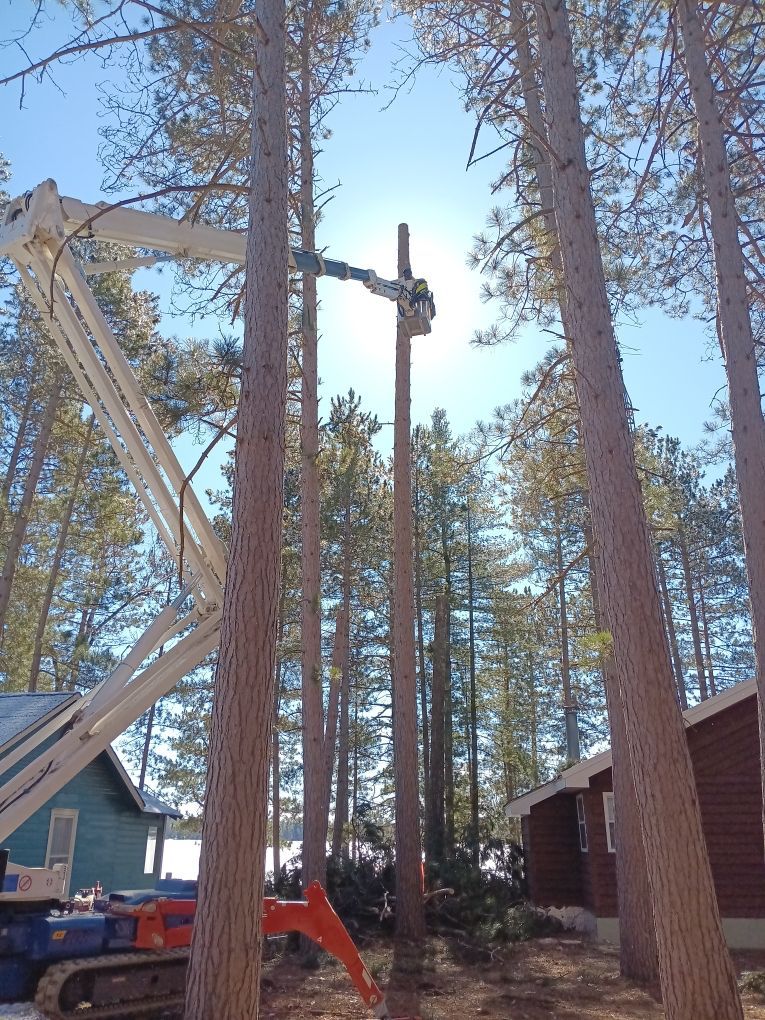
Building a trail that holds up starts with the corridor itself. Clearing brush, deadfall, and hazard trees along the intended route comes first, followed by lifting the canopy overhead so the path has enough clearance for walking, biking, or whatever the trail is ultimately meant to be used for.
Surface material matters as much as the layout. A wood mulch top layer offers soft, stable footing, keeps weed growth down, and can be reshaped or refreshed as needed over time, unlike bare dirt, which tends to compact unevenly and erode wherever water naturally collects along the route.
Stumps and root systems within the corridor typically get addressed with compact, skid mounted equipment suited to tight access areas, and ground protection mats help limit rutting and soil disturbance during the work itself. Timing the work around rainfall and soil moisture also plays a role in how well a new trail holds up once it's finished, since working wet ground tends to cause more disturbance than working it dry.
Happy Customers in Arbor Vitae, WI
Why Arbor Vitae Landowners Trust Michlig Tree Service
Reading a property's terrain correctly before cutting a single path is what Michlig Tree Service brings to every job, which is why Michlig Tree Service has provided expert trail building in Arbor Vitae, WI, for landowners who want a corridor built right the first time, not redone the following season.
Licensed, certified, and insured crews carry out every job, with training that covers everything from hazard tree assessment to proper equipment use in sensitive, wooded terrain. That background matters on a trail project, since the route has to account for tree health and safety just as much as where people actually want to walk, bike, or ride through the property.
Ground protection mats and compact equipment limit disturbance to the land during every job, treating each property the way we'd want our own treated. That attention to detail is part of why so much of our work in this area comes from repeat clients and referrals from past customers throughout the Northwoods.
Hire Us! Experienced Trail Building in Arbor Vitae, WI
Experienced trail building in Arbor Vitae, WI is what Michlig Tree Service provides, and a well-planned corridor makes every season on a wooded lakefront property more enjoyable, whether it's used for walking, biking, dog walking, or reaching a favorite spot on the water nearby throughout the year.
Give us a call to talk through what you have in mind, whether that's connecting two parts of a property, widening an existing footpath, or clearing a brand new route from scratch through untouched woods. We'll walk the land with you before any work begins, so the finished plan actually matches the property.
From small footpath refreshes to full corridor clearing on larger wooded parcels, we bring the same equipment, the same ground protection practices, and the same close attention to a property's specific terrain to every trail project we take on, regardless of how big or small the job turns out to be for the landowner in the end, season after season.
Frequently Asked Questions
1. How wide should a trail be for walking versus biking?
Width depends on intended use. A footpath for walking might only need to be a couple of feet wide, while a trail meant for biking, dog walking, or side by side walking typically needs more clearance on both sides.
2. Can you build a trail without heavy equipment damaging my property?
Yes, we use compact, skid mounted equipment designed for tight access areas, along with ground protection mats when conditions call for it, to reduce rutting and soil disturbance so the surrounding land looks undisturbed once the work is finished.
3. What's the best surface material for a wooded trail?
Wood mulch is a common choice because it provides soft, stable footing, holds down weed growth, and can be reshaped or topped off as needed. The right material ultimately depends on the trail's intended use and the site's drainage.
4. Do you handle stump and root removal along the trail route?
Yes, we grind stumps with compact, skid-mounted equipment and remove unwanted root systems within the corridor. We also perform standard root pruning near the trail to help keep nearby trees healthy while reducing tripping hazards.
5. Can an existing overgrown footpath be widened instead of starting over?
Often, yes. We can assess an existing path and widen it, clear overhead canopy for better clearance, and improve the surface without necessarily rerouting the whole thing. Reach out and we can take a look at what you're working with.
6. How do you handle hazard trees along a planned trail route?
Hazard trees along a corridor get evaluated individually, since a leaning or declined tree near a walking path presents a different level of risk than one further off the route. We address these as part of the overall trail layout.
7. Will a new trail need maintenance after it's built?
Some seasonal upkeep, like re-mulching or clearing new deadfall, helps a trail hold up over time, especially through freeze and thaw cycles. We're happy to talk through what a maintenance routine could look like for your specific property.
8. Can a trail be designed for hunting or tree stand access?
Yes, we regularly build corridors specifically for hunting land, including routes designed for quiet access to a tree stand. Send us a message with details about the property and what you're trying to achieve, and we can plan accordingly.